
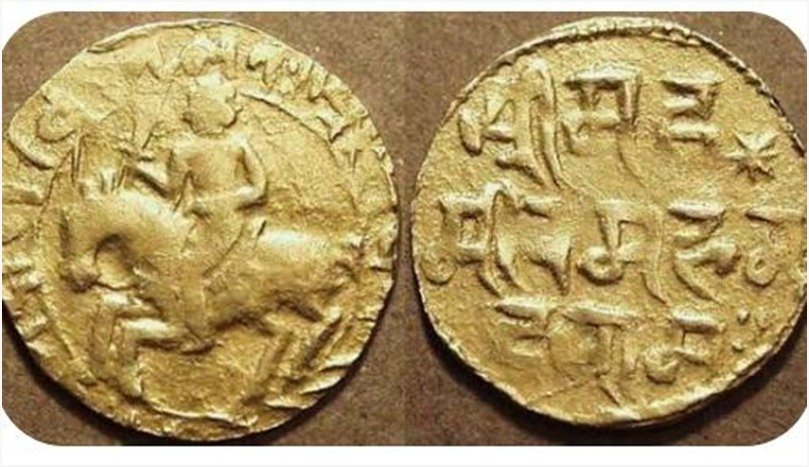
Jyotishman Sarkar,M tech Material Engineering For over a century, mainstream South Asian numismatics has accepted a highly specific narrative: that the famous gold and silver horseman coins bearing the Nagari script “Samvat 1262 Bhadrapada” were minted by the Ghurid general Muhammad Bakhtiyar Khalji to commemorate his conquest of Bengal. By translating “Samvat 1262” using the North Indian Vikram Samvat era (1262 – 58 = 1204 CE), historians fixed the date of the Islamic invasion of Bengal to August 1204 CE.
However, a critical epigraphical and regional analysis exposes deep flaws in this timeline. In eastern India, “Samvat” did not inherently imply the Vikram era. Applying the regionally dominant Saka Era shifts the coin’s date forward by 134 years to 1338–1340 CE (1262 + 78 = 1340 CE). This math lines up with the reign of Fakhruddin Mubarak Shah, the independent Sultan of Sonargaon, revealing that the narrative of a 1204 CE Khalji coin was a fabricated timeline designed to validate a non-existent historical rule.
- The Regional Argument: The Dominance of the Saka Era in Bengal and Bihar
The primary error in the standard reading is the arbitrary application of the Vikram Samvat. While the Vikram Era was common in Malwa and parts of Central/North India, it was not the traditional system of timekeeping used by the scribes and kings of medieval Bengal and Bihar.
● The Sena and Pala Precedent: The Sena dynasty, which Bakhtiyar Khalji reportedly displaced, migrated from the Deccan and strictly utilized the Saka Era (which begins in 78 CE). The regional stone inscriptions and land grants of this era heavily favor Saka dating.
● The Scribe Factor: Early Muslim invaders did not bring Sanskrit-speaking mint masters with them from Afghanistan. They relied entirely on local Hindu moneyers and engravers to strike coins with Nagari legends. A Bengali or Bihari mint artisan tasked with engraving a date in the native language would naturally use the prevailing local calendar—the Saka Samvat. - The Correct Chronological Math: 1262 is Actually 1338–1340 CE
When we clear the regional bias and calculate the date using the local Saka standard, the timeline undergoes a massive shift:
Saka Era 1262 + 78 = 1338 AD
(Note: Depending on whether it refers to an elapsed or current astronomical year, Bhadrapada 1262 Saka aligns precisely between 1338 CE and 1340 CE).
This completely upends the early 13th-century timeline. A coin minted in 1338–1340 CE cannot belong to Bakhtiyar Khalji, who died in 1206 CE. This reality points directly to a different era of Bengal’s history.
3 Fakhruddin Mubarak Shah and his Rebellion
If the coin belongs to 1338–1340 CE, who actually minted it? History provides a flawless match: Fakhruddin Mubarak Shah (who reigned from 1338 to 1349 CE).
Standard Colonial Narrative:
[1204 CE] ── Bakhtiyar Khalji Conquers Bengal ── Strikes “Vikram 1262” Coin
The Corrected Regional Timeline:
[1338 CE] ── Fakhruddin Mubarak Shah rebels against Delhi ── Strikes “Saka 1262” (1338-1340 CE) Coin
● The Geopolitical Context: In 1338 CE, Fakhruddin broke away from the tyrannical rule of Muhammad bin Tughluq of Delhi and declared himself the independent Sultan of Sonargaon (Bengal).
● The Need for Sovereignty: To solidify his status as an independent sovereign ruler independent of Delhi, Fakhruddin required immediate, aggressive minting of coins (the Islamic tradition of Sikka).
● The Imagery: The galloping horseman holding a mace or lance is an iconic motif of local cavalry. Minting coins with local Nagari text (“Samvat 1262 Bhadrapada”) was a deliberate political strategy by Fakhruddin to win the allegiance of his predominantly Hindu subjects in Bengal during his rebellion against the Delhi Sultanate.
- Why Was the Meaning Twisted? Fabricating a Early Conquest Narrative
If the math and regional context point so clearly to the 14th century, why did colonial and modern historians twist the coin’s meaning to fit the year 1204 CE?
The answer lies in political validation. Early historians eagerly sought tangible numismatic proof to corroborate the dramatic accounts written in the Tabaqat-i-Nasiri (an Islamic chronicle written decades later that claimed Khalji captured Bengal’s capital with just 18 horsemen).
By intentionally mislabeling the Saka date as Vikram Samvat, imperialist and early nationalist historians managed to: - Invent “proof” for a massive Ghurid conquest that lacked contemporary administrative evidence.
- Validate the rapid, uncontested fall of the Sena Kingdom.
- Establish an early Islamic ruling timeline in Bengal that was practically non-existent on the ground at that time.
Conclusion
The “1262 Bhadrapada” horseman coin is not a relic of an early 13th-century Turkish raid. It is a symbol of 14th-century Bengali independence. Forcing a North Indian Vikram Samvat calculation onto an eastern coin ignores basic regional history. When calculated correctly using the Saka Era, the coin rightfully belongs to Fakhruddin Mubarak Shah around 1338–1340 CE. It is time for modern numismatics to correct this error and strip away a fabricated historical timeline.
If you want to refine this piece further, let me know if you would like to:
● Add more detail on specific Sena dynasty stone inscriptions that prove Saka dominance.
● Incorporate detailed numismatic descriptions comparing the calligraphy of Fakhruddin’s known coins with the horseman coin.
● Adjust the tone to be more academic or more journalistic.
