
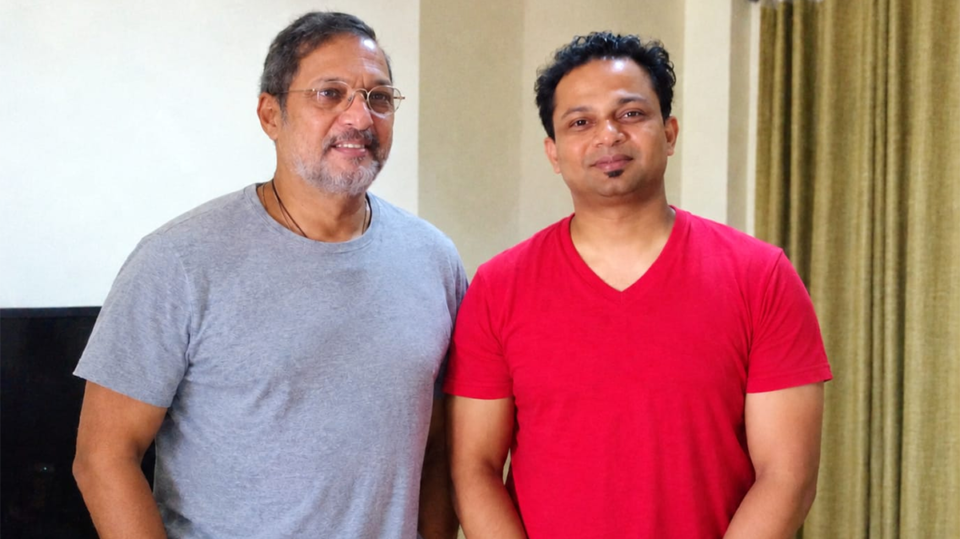
By Dr. Shubhro Chakrabarty
“Bahut log meri mimicry karte hain, lekin Shubhro, tune mujhe jiya hai.” In other words, “Many people imitate me, but Shubhro, you have truly lived me.” These words, spoken by the legendary Indian actor Nana Patekar, remain vivid in my memory even today. Hearing such appreciation from an actor I deeply admired was more than a moment of happiness for me. It was a deeply moving experience that enriched my understanding of art, human emotions, and life itself.
My first memorable encounter with Nana Patekar took place on November 12, 2016, at the convocation ceremony of the National Institute of Technology (NIT), Agartala, in Tripura. It was an important day in my life, as I received my PhD in Electronics and Communication Engineering. The occasion became even more special because Nana Patekar was also present and was conferred an honorary D.Litt. degree.
The previous evening, during an event, I had performed an imitation of Nana Patekar. I tried to recreate his distinctive dialogue delivery, voice modulation, expressions, and body language. After the performance, I received a warm response from him. He looked at me and said, “Shubhro, tu kamaal hai!”—“Shubhro, you are amazing!”
However, what he said to me the following morning was even more precious. He remarked, “Bahut log meri mimicry karte hain, lekin Shubhro, tune mujhe jiya hai.”
Those words meant much more to me than a compliment. I felt that he had recognised the effort I had made to understand not just his mannerisms, but also the emotions and depth behind his performances. His words helped me appreciate the difference between merely imitating someone and genuinely understanding and embodying the spirit of a character.
My association with Nana Patekar, however, was not limited to acting or that one unforgettable moment. Another aspect of his personality deeply inspired me: his commitment to society and his concern for people in need.
During my visit to Goa, I had the opportunity to volunteer for several days with the Naam Foundation, an initiative associated with Nana Patekar and Makarand Anaspure, established in 2015. The foundation works to support farmers and vulnerable rural families. My experience there gave me a closer look at the humanitarian side of a man widely admired for his powerful performances on screen.
What impressed me most about Nana Patekar was his simplicity and sensitivity towards human suffering. Fame, popularity, and professional success had not distanced him from ordinary people. Instead, his actions reflected a belief that one’s abilities and achievements should be used to help others. Witnessing this approach to life left a lasting impression on me.
Before I travelled to South Korea in 2018, I had another meaningful conversation with him. He encouraged me to learn as much as possible, gain experience, and make the most of the opportunities available abroad. At the same time, he reminded me of the importance of returning to my own country and working for its people.
His advice carried a powerful message. Acquiring knowledge and international experience is valuable, but applying that knowledge for the benefit of one’s own society is equally important.
I returned to India in 2021. My decision was influenced by several personal and professional considerations, and it would not be accurate to attribute it solely to Nana Patekar’s advice. Nevertheless, his words had influenced my thinking and strengthened my belief in using knowledge and experience for a larger social purpose.
In 2024, while I was working as a professor at D. Y. Patil International University in Pune, I had another opportunity to meet him at Khadakwasla. Our conversation touched upon education, the future of young people, employment, self-reliance, and the responsibilities individuals have towards society.
During that interaction, I was once again struck by his practical outlook. He was not merely concerned about discussing problems; he also seemed interested in how individuals could contribute to positive change in their own spheres of influence.
I have always believed that education should extend beyond earning degrees or achieving professional success. Its true purpose is to develop a person’s ability to think critically, acquire practical skills, and act with a sense of responsibility. This belief also informs my work through the Knowversity Foundation, where I seek to promote practical education, technology, research, and meaningful social impact.
One of my key objectives is to help make education more relevant and effective for young people, particularly in Tripura. As I continue working towards this goal, I often find myself reflecting on the values I observed in Nana Patekar.
From him, I learnt that a person’s true identity is not defined solely by their profession, public recognition, or achievements. Genuine greatness is reflected in compassion, the willingness to stand beside others in difficult times, and the ability to use one’s talents for the greater good.
Looking back at my encounters with Nana Patekar, I realise that certain meetings leave an enduring mark on one’s life. His words continue to inspire me, reminding me that understanding another person requires more than observing their actions. It requires empathy, sensitivity, and a willingness to appreciate the emotions and experiences that shape them.
My association with Nana Patekar was therefore much more than a series of encounters with a celebrated actor. It was a deeply personal and human experience that repeatedly reminded me that success is not simply about what we achieve for ourselves. It is also about how we use our knowledge, experience, and abilities to bring positive change to the lives of others.
The appreciation I received from him, my experience of witnessing his social work, and the conversations we shared remain among my most cherished memories. Whenever I reflect on education, society, and the future of young people, those moments return to my mind.
And above all, I remember that one sentence—a recognition that meant far more to me than praise for an imitation:
“Many people imitate me, but Shubhro, you have truly lived me.”
For me, those words will always remain a reminder of the power of empathy, the importance of understanding others, and the lasting influence one person’s values can have on another’s life.
The author is a scientist, an academic, and the founder of The Knowversity Foundation.
